20 August 2007

The Garden House

I guess that it's time to tell you about the house where I stayed in Arcata. I sublet a room in a shared house that I found through craigslist. Here's why it's called the Garden House.


I saw photos of the house from when the present owner bought it. The front and one side were covered by flat empty lawn. The third side by concrete. The only concrete left is a narrow strip in front of the gargage that is used for a patio.

The house is in the 'bottomland' on the ocean side of the town. It was originally salt marsh and would now not be zoned for building. Under the house is a sump pump for the rainy season. Fortunately, it wasn't the rainy season 'cause the pump is broken. There was no refrigerator in the house. Instead, there is a hole in the dining room floor that used to be part of the defunct central heating. A three sided box is set into the square ducting and used as a cool box. For most things, it worked ok, however, milk only lasted a couple days and I had to buy my beer cold and drink it as soon as I got home.

It was only a fifteen minute walk into town and another ten minutes up into the hills where there is a redwood forest remnant that is a city park. This is the lawn of the park.


Redwoods are amazing trees. Some of the oldest and tallest on earth. There is a tree that is living and they drive cars through! Not my kind of thing but it gives you and idea of their potential size. These are second growth forests. Still, the trees have a very soft bark. To be in a redwood forest is to be in a very gentle place. I would hike up into the forest and play my flute some days.


The Buckey Walters

Kitty corner from the Garden House lived a couple members of the Buckey Walters. The Buckey Walters are a bluegrass band and I could occasionally hear banjo being played over there. The mandolin player dropped in occasionally and we became friends. I heard them my first weekend when I biked an hour inland to the the annual Humbolt Folklife Festival at the little town of Blue Lake. They were one of my favourite acts of the day.

There is a town down the coast on the other side of the mountains called Boonville. In Boonville, they have their own slang called 'Boontling'. 'Buckey Walters' is what they called the phone box.


Don't know where to stick this photo. I thought it was a new age shop but it turned out to be a hairdressing salon.

19 August 2007

The 1% Program

The following is a letter I sent to the Byron Shire Echo:

Hello Friends:
I am visiting a city of 17,000 on the far north California coast. This university town, Arcata, has two health food shops each the size of Woolies. One of them, a cooperative, has at it's check out line a list of about twenty local not-for-profits with a code number next to each. A customer can request that an addtional 1% of the total cost of purchases be added as a donation to a not-for-profit selected from that list.

I consider this a great idea. It is totally voluntary for both the merchant to initiate and for the customer to participate. Say your purchase is $30.00. 1% is only $.30. Negligible for the customer but it all adds up. The merchant could send off a cheque when the sum is large enough and at a convenient time. With the computerised cash registers, once set up, the adding of the 1% would be easy.

It only takes one merchant to start this program. Of course, the more the merrier and if enough merchants were involved, they could display a placard, 'Member of the 1% Program'. There could be literature available for visitors to the shire explaining the benefits to the community that they so like to visit. Perhaps the NCRF might want to consider a role.

So, there ya are.

G'day, Kundan Ewan

Ahhh, how I miss hearing g'day, mate, no worries....

11 August 2007

Kundan's New Obsessions

Just before I left Japan, I began a new writing project. It involves a fictitious large intentional community. While doing research, I came across a book, 'Village Wisdom, Future Cities' that is a collection of presentations from the Third International Ecocity and Ecovillage Conference in Senegal in 1996. I have found out that the next 7th International Ecocity Conference is happening in San Francisco next April. So, after returning to Australia next January, I will then be coming back to California for the conference. Then, back to Oz by July 2008 for the International Shakuhachi Society Conference in Sydney.

Ecocity Conference website: http://www.ecocityworldsummit.org/index.htm

Shakuhachi Conference website: http://worldshakuhachifestival08.com/index.html

I was concerned about all the flying as it is such a high carbon count. Then, I discovered a study done at Tufts University about companies that trade in personal carbon credits. (Some of these companies are not ethical. They do such things as sell credits for projects that would happen anyway.) Of the recommended companies, one was australian- http://www.climatefriendly.com/

So, I will be paying an extra AUD$163.61 to Climatefriendly for carbon credits when I fly to SF for the conference next year.

I'm not sure how but Byron Shire will be hearing from me on this subject in the not to distant future.

Kind of in the same vein: I have been looking at recumbent cycles for a couple of years. My favourite is made just south of San Francisco; the EasyRacer. I was feeling that soon I would jump in and purchase one, however, the price for the EasyRacer Tour Easy is an initial US$2000.00. Then, there are the accessories.
The gods must have been happy with me, becaus the other day I went on the Australian ebay site and found a recumbent for sale. It was designed by EasyRacer but built by Sun. The model is the Sun Sport LE. It is similar to the Tour Easy.It was for sale for less than half what I would pay new. This was the second time that the guy had listed the bike and I was the only bidder. I won the bid and Tony Parker has very kindly agreed to take delivery for me. I'm itching to give it a go. Here's a photo.

18 June 2007

The Hills Are Alive With Kundan's Sanpo

"Sanpo"- to stroll or walk.

Finally, I have moved from wandering around the streets of Chichibu to hiking along the trails in the surrounding hills. Chichibu being in a valley, this gives me quite a few choices. I have begun getting out of the house by 7 AM a couple times a week to be have the hills to myself. Even on a weekend when the trains are chock-a-block with designer casual outdoor clothed hikers, I will be ahead of most all of the others. It is only ten or fifteen minutes on my bike to the beginning of a trail.

One Saturday, I crossed the river and saw a man with a daypack heading up a small road. I followed him and then stashed my bike. When I looked around he had disappeared into the entrance of a trail. Following him I discovered a sign at the point where the trail disappeared into the trees. Now, I often encounter signs on trails and have no idea what they are saying. It doesn't even bother me when I find myself twenty minutes later at a dead end up some valley.

However, the sign that you see in the photo has, yes, the silhouette of a bear. Hmmm, it would have been a bit more reasurring if I could have understood what it said below. I suspected that they were tips on what to do if you come across a bear or maybe how to avoid a bear. Well, I figured that the guy in front of me would distract the bear and I travelled on. A few more signs and fifteen minutes later, the trail ended at a road. I survived. Yes, I was listening for any rustling and I was concerned about the strong smell of the banana in my daypack.

Kaoru translated the sign for me:


Bear sighting, take care!

How not to encounter a bear:

1) Don't go into the forest.

2) Let the bear know you are here. When you get into the forest, use a radio or bell.

3) Don't walk alone in the forest.

4) In the early morning,evening,and when the weather is bad, the risk increases.

5) Don't leave edible garbage.

Hmmm,


As I said, there are quite a few choices for me when it comes to trails. One day, I took off riding, went up a road at random and found myself in a valley that ended part way along a trail that starts in the city centre and finishing some ways later at a couple temples. Chichibu has thirty- four temples and assorted shrines. The trail I had come upon leads to temples 26, 27 and 30. My first time, I took a wrong turning and found myself twenty minutes later up a dead end in a small valley. It was lovely. I sat down, had my snack and played my shakuhachi.

A few days later, I rode my bike back up the little valley and set out again. Almost immediately, I was going very steeply up hill for almost half a kilometre. There were a few stops to let my heart and breathing slow down. Once I reached the ridge, it was ups and downs along winding a narrow trail with large rock jutting out and large roots to watch for.


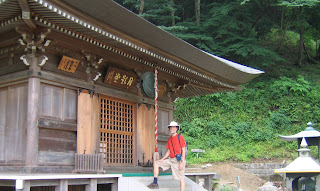
Here is the approach to a small temple.


Just beyond the temple,
a small shrine with an inscribed stone.

In the centre of Chichibu is the main temple. In its outer courtyard is an inscribed stone. The inscription is a poem written by Kaoru's father. I have noticed similar large and small inscribed stones in public parks on trails and at shrines. I like this; having public poetry. There should be more of it.

Check out Temple 26.


I took a long break there.


I thought it would be a short stroll to Temple 27. It was more rugged trail and along the way, my foot slipped on a large stone I was crossing. It turned out at the ankle and though it didn't feel injured, I was concerned.

As Temple 27 was at street level, I decided to walk back along the streets to my bike. I had been walking along mountain paths for over two hours. I needed the flat for a while. It took me half an hour to find the little road up the valley and I was loosing energy. However, as I moved up the valley and the houses became fewer and the trees more, the energy magically returned.


Another Stroll-

Looked out the window Sunday morning. Overcast. Cabin fever was strong. 'No dark clouds. It won't rain.' I put my shak, camera and some snacks in my daypack. Full bottle of water. Slipped on my walking shoes. Tilley hat on my head and I was ready to go. I headed out on my bike and took a main road up the valley paralleling the railroad tracks. Forty- five minutes later, I saw the sign for Minoyama Park. 'Yama' means mountain. The mountain didn't look that tall and the name sounded nice, so, I parked my bike and started walking up the road. Shortly after the 1.5 kms marker, I saw a sign pointing at a trail that led off heading up the hill. That was what I was looking for. The trail went up and up. It was a one-step-at-a-time half a person narrow eroded track that was constantly up hill. No gentle slopes or switch back, just up and up and up.


Forty-five minutes later, I saw a tori up ahead. A flat spot! I started changing gears and by the time I reached the tori, I was in stop and relax mode.


Then, I saw the steps!
I stopped for a rest anyway. There was shelter with benches but when I sat down and pulled out my snack, I was swarmed with mozzies. I ate with one hand as I swatted with the other.


After my 'rest', I went up the steps and then followed another easier trail for fifteen minutes to the top of the mountain. At that point, I came across a wide paved path. A look around and then I followed that path along the ridge of the mountain top to find the park. There were picnic spots, viewing platforms, toilets and maybe thirty people. Many of whom had their cars parked in the lot.

Many of the people were wearing their hiking gear with day pack, hiking poles and all. I hadn't seen or heard anyone else on the trail. I was hoping they hadn't driven up to walk around dressed like that. They were breaking out their lunches. I just had a little snack with me. I took some photos. You golfers; how would you like to play on that course?


This photo of Chichibu is only part of the city. Gives you and idea how big it really is. The haze in the photos is because of the high humidity. In fact, the humidity got so high that it started to sprinkle. This was a sign for me to head back down. I didn't want to be caught on the trail when it got muddy. So... not really having stopped, I went back along the nice wide paved path to the beginning of the trail that I had come up. My whole being balked. I couldn't go down that trail. I continued on the nicely paved pathway.


This sign photo was taken soon after.
Yes, I think that's what it means.


The paved path came to an end but there were people in their latest hiking gear just coming up off a trail that continued down hill. I passed them and found myself on this very gently sloping trail. At times, it was even flat. At times, it was covered with a soft layer of leaves. A few switch backs. I easily wandered on down to the road. I discovered that this easy trail had it origin only twenty metres beyond the beginning of the previous trail that I had struggled with on my way uphill. Good old, Kundan, not one for research.

Back at my bicycle, it was still lightly sprinkling. I hopped on and started pedaling. I knew that I still had forty-five minutes before I got home but the pedals turned easily enough and I made good progress. Most of the way, there was a wide path with a barrier between myself and the heavy traffic on the main road. At times, that would disappear and I would turn off onto a side road. Very pleasant these side roads. Farm houses and fields. A few rice paddies. The rain was warm, the air temperature in the mid twenties. My Tilley keeping my head dry. I was quite comfortable. Cruising along. Calmly pedaling when I saw this-

I was so excited. An original old style japanese farm house. This is very rare these days. You almost have to go to a museum village to see one any more. I took three snaps in the rain. The roof is in such good condition. See how one of the walls has some of the mud fallen off revealing the wattle beneath. This made my day. I was so chuffed.

Next side road revealed the temple below. I ducked out of the rain in the gateways. Very new and beautiful.


The plan was to keep pedaling all the way home. I figured that if I stopped for a rest I would never get going again. I almost made. I started to pass a sushi restaurant. It pulled me in. They even had an english menu for me. After a light repast, I was on my way and home in ten minutes. Five hours after I left.

I was so happy with my day out. Whow!

But, my god, was I buggered. Took my body two days to recover.

17 June 2007

Kyudo

A week after my arrival, I was passing by the little dojo near here when I saw that someone was in there. With my very limited Japanese, and much pointing, I managed to understand that something was happening that Sunday.

I arrived on Sunday just as they were finishing up a dojo competition. There were a dozen people there. The winner of the day received a trophy and a box of laundry detergent. Everyone else received a box of laundry detergent. Then there was tea and snacks. I was made very welcome. Only one man spoke a little english but I managed to answer most of their questions and let them know that I had practiced Kyudo and had a ranking. At this dojo, I am one of the younger ones. Few are below fifty. One of the regulars is eighty-three. He shoots very well. The woman on the right and below is sixty-five and very fit and alive.


While most everyone was leaving, the president of the dojo asked if I would like to shoot. I didn't have any of my equipment with me and so I zipped home and got my bow and arrows and glove. With Japanese archery, you wear a leather glove with a large thumb lined with wood and a nock at the base. There are either two or three fingers as well. When you are learning or warming up, you shoot at a round bale of rice straw approximately two metres away. That way you can concentrate on your form. I shot a few arrows as the few people still present watched. I was pleased with how quickly most of it came back to me. I actually did my previous teachers proud that day.


I began going regularly the next day. My first strike of the target was a bulls eye! (The targets are paper stretched across a wooden hoop and set four inches above the ground in a sand bank at 28 metres from where one shoots.) The most difficult thing in the early days was putting on my obi (sash) and hakama (the lower part of the outfit). There are special ways to wrap and tie everything.

Progress in my shooting was swift and there was rarely a round when I wasn't hitting the target at least one out of four arrows. The Kyudo form has eight steps. The form in a test is begun from a kneeling position. Returning to a kneeling position between each shot. In practice we sometimes make the first set of two arrows with the full ceremonial entry and the kneeling beginning. The rest of the time, we just start from a standing position. When you are shooting, you line up in a row and take turns. Our dojo accommodates three people shooting.

Each of the eight steps of the form has a purpose. I practice with all eight steps. However, in many cases, during practice many people will skip one or more of the steps. This is their choice but they tend to miss some of the benefits of the art on both and outer and inner level. The form establishes grounding, and balance with coordiantion of the musculature and the breath. My own experience is that when practiced correctly, I reach a state of body/mind that is relaxed and strong and 'in the zone'. Several times, I have released the arrow knowing that it was going to hit the target because I could feel it to be so.

In an exam, the form is the most important part. Some competitions, they give prizes for best form as well as how many hits of the target as I remember. I have seen people with very bad forms who hit the target time and again. I witnessed one former professor who chattered away and shot in a slip shod way and hit the outer target regularly.


So, for a few weeks, I was practicing six days a week. My fellow members of the dojo had me lined up for the next exam in September and I was quite certain that I could pass easily. Then, my shoulder started aching. And, aching more. This is from an injury I accumulated almost twenty years ago when a ladder slipped out from under me and I landed on my side cracking my skull. The shoulder was not given any attention at the time as it didn't dislocate and the doctors didn't notice that it was riding higher in spasm. It took a body worker to point it out to me. It only started to bother me a year ago and acupuncture treatments have helped immensely to relieve the aching feeling. Well, by the time that I realised that I needed to stop shooting, the shoulder was getting very painful.

I went to an acupuncturist for a couple of treatments and took three weeks off from the archery. I have returned to the dojo. However, I only go two or three times a week for shorter periods of shooting. My fellow archers missed my presence and I missed their company. The shoulder is doing ok though I have to be aware and stop shooting when it tires.

The first day back from my break, I was introduced to a man I hadn't seen before. He is referred to as the 'Sensei'. (He is in the top two photos) He is very friendly and has given me instructions which at first changed my form so that I wasn't hitting the target but eventually made for a better form. Additonally, my shoulder is not bothered so much.

So, I shoot on.


The Shakuhachi


One of Kakizakai sensei's Australian students, David Dixon, a viola player at the Sydney Opera House told me about when he and a couple other of the Aussie students were wandering through an antique shop near here. They came across some second hand shakuhachis which they tried but turned out to be of very poor quality. There was a man there who did restoration work and upon discovering that they were students of shakuhachi sat down with a paper and his brush. With two strokes he drew Mount Fuji. At the foot of Fuji, he drew a squiggle representing a snail. He then said "To learn shakuhachi is like a snail trying to climb Mt Fuji."

David told me this story after a lesson when I had not been able to make a sound on my shak. I spent the half hour just moving my fingers and blowing in time with the music. Kaoru (Kakizakia sensei is called by his first name by his foreign students) had assured me that I had done fine. At that point, my rhythmn and fingering were most important. "When a master has a bad day, we wouldn't recognise the difference. When a student has a bad day the difference is very evident."

I later went through a minor freak out about it and hence David's story. That story has become important to me. It helps me to appreciate every little improvement in my playing. It had only been a few weeks and there is quite a bit that I had learned in such a short time. Shakuhachi study is measured in years, not weeks.

Perhaps the intensive way in which I am studying and living has caused me to think of my time with the instrument as being longer than it really is. I have three lessons a week. Monday and Wednesday here in Chichibu and Saturday I ride into a Tokyo suburb where Kaoru teaches at his in-laws house.

Saturday's lesson is when we tend to sit in on other student's lessons. For me, I enjoy it and learn from it. I get to hear more advanced pieces. A woman student is learning a duet at the moment. Very beautiful. I also get to hear Kaoru playing live, which is very important in the learning. To hear his playing helps me to tune my ear to the sound of the shak and the possible variations of sound available.

When I began my studies with Kaoru, it was the beginning of my real learning. I had been blowing on my shak for six months and had had two lessons in Oz, however, I started from the beginning with Kaoru. He puts a lot of emphasis on the embouchure. That's the shape of the lips but also the inner mouth as well. It was my seventh lesson before he told me that I had a basic understanding of the different elements. That was many lessons ago and I'm still working on my embouchure. It has improved alot, however, to hear me play 'ro' (the lowest note) and hear him play the same note...

One of my biggest challenges has been to relax while playing. I am moving closer and closer to this state and as I do so I discover many things. Of course, during my lessons, the fantastic abilities that I had reached at home magically disappear.

A little about the music notation. Each traditional instrument in Japan has it's own notation system. And, for each instrument, there are several schools. The Shakuhachi has three current ones that I know of. Each school has it's own notation system as well. So, when different traditional instruments play together, I have been told that they use the western notation system, which is very different from what I am learning. The notation system that I am learning uses symbols from the phonetic alphabets. It's sort of like "do", "re", "mi" in the west. Time is marked with small slashes and different octaves of the same note are like wise indicated with various marks. Partial tones are indicated with marks across the note symbols. I find it easy, most of the time.

Having only five holes in a piece of bamboo means that various notes are created by uncovering parts of holes and tilting of the head. Having Kaoru demonstrate helps immensely.


Now to the picture. That's my new shakuhachi. Last September, I purchased a shakuhachi made in Australia out of Tasmanian Tiger Myrtle. My first lesson with Kaoru, he asked to play it. I passed it right over. He quickly discovered that one tone was flat. He asked if I would like him to fix it. I said, "of course". He went to his tool kit, pulled out a knife and started carving the inside of one of the holes. Several scrapings and blowings later, he was satisfied. He then carved the outside of the bottom hole to make it more oval. This, he explained, would make it easier to play some notes. I asked him about buying a new shakuhachi while I was here. He told me that he would recommend the shakuhachi's made by Miura-san. If I could not afford that then for half the price, he knew another maker in Tokyo whose flutes were of consistent quality. I thought on it for a few days. At the next lesson, I spoke with him again about buying a new shak. He gave the same recommendation. He said, "A student should play a Stradavarius. A master can play a lesser instrument." I asked him to order a Miura for me. I said that I would transfer the money to his account the next day. He said to wait until the shakuhachi had arrived. He then said, "One never knows how long it will take him to have the shakuhachi ready for you. I will explain that you will be leaving in six months and maybe it will be ready before you leave." !!!

I later learned that people expect to wait up to a year for one of Miura-san's shakuhachis.

Next lesson, Kaoru explained that he had spoken to Miura-san. The price of his flutes had gone up by $1000.00. However, he happened to be making a 1.8 shakuhachi at the moment and he would let me have it at a discount. I considered for half a second and said, "Yes". Two weeks later I had my new 1.8 shakuhachi. I took it home and couldn't stop playing it. It was like having a new lover. The sound is beautiful and it is easier to play.

I should explain that shakuhachi come in different lengths. The longer the shak the lower the tone. A "shak" is a measure roughly equivalent to a foot (30cm). "Hachi" means eight. So, 'shakuhachi' actually means 1.8 shak. The 1.8 is the length that one begins with. Most of the shakuhachi music that you hear is played on longer shakuhachis; 2.2, 2.4, 2.7. 3.0. I asked Kaoru if you needed more power to play the longer shaks and he said that the real difference is that you need to be more precise. Hence the beginning with the 1.8. Though most recordings are of the longer shaks, the 1.8 makes a beutiful sound and is also a pleasure to hear.

At the end of my last lesson til next October, Kaoru said, "Beginners do not increase their skill gradually. They go along at the same level and then jump suddenly. To keep going until that jump happens is very difficult. You made that jump." I know exactly the day when that happened. About ten days ago, during a lesson, a part of the puzzle fell into place that made a huge difference and brought so many elements together. I'm feeling ready to be away from my teacher for three months.

16 June 2007

The Farewell Party


Here is a photo from my sensei's website. This is how he looks when he is performing. It is strange for me to look at this photo because I am used to seeing him in jeans and a t-shirt. He and his wife Megumi have been very good friends to me. Below is a photo from a farewell party they threw for David and me.


Kaoru, my teacher is on your left.

Megumi is beside me. She plays and teaches Koto. She started when she was three years old! She also practices Sho-do, which is the drawing of the Kanji.

Haruku (Haru), is directly in front of Megumi. He's 17 years old. Last year of High School. He's on the basketball team.

Emi, is in front of me. She's 15 years old. High School. She loves throwing the javelin. Travels everyday to her school to practice the javelin.

Takashi (Acchi) is up on the ladder in the back. He's 13 years old. Also, basketball player. His favourite subject- English. He also loves to cook. He prepared the meal they invited me to when I first arrived.

David is between Kaoru and me. The guy at the front Yayuen, a friend of David's who is Chinese/Australian and studying Classical Japanese Literature at Waseda Uni in Tokyo. The dude with his shirt up is Lachlan from Perth, another of Kaoru's students. The girl in front of him is his friend, Masaki. David changed her name to Mo' Sake!

Yes, it was a fun night.